
Hip avascular necrosis: understanding hip pain
A hip can be in trouble for months before an X-ray shows anything at all. That is the difficulty with avascular necrosis, and the reason it is worth knowing the name.
What it is
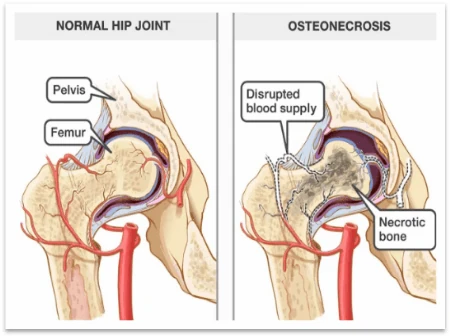
Bone is living tissue with a blood supply. Avascular necrosis – AVN, also called osteonecrosis – is what happens when part of that blood supply is cut off and the bone it fed begins to die.
In the hip it usually affects the femoral head, the ball at the top of the thigh bone that sits in the socket of the pelvis. Dead bone is weaker than living bone. If enough of it is affected, the ball can lose its round shape and collapse, and once the surface is no longer smooth the joint wears quickly and becomes arthritic.
That sequence is the whole reason this condition is treated differently from ordinary arthritis. The arthritis is the end of the story, not the beginning, and the beginning is quiet.
What causes it
Sometimes the cause is obvious. A hip fracture or a dislocation can tear the vessels that supply the femoral head, which is why a broken hip is treated urgently rather than simply rested.
Where there has been no injury, the known risk factors include:
- Long-term corticosteroid treatment, particularly at high dose. Short courses at low dose carry little risk.
- Heavy alcohol use over a long period.
- Smoking.
- Sickle cell disease and some other blood disorders.
- Lupus, rheumatoid arthritis and similar inflammatory conditions.
- Chemotherapy, radiotherapy or an organ transplant – partly through the steroids used alongside them.
- Decompression sickness, in divers.
In a good number of patients no cause is ever identified, and that does not make the diagnosis any less real. It is also common for both hips to be affected, even when only one of them hurts.
The symptoms, and why they get dismissed
Early on there may be nothing to feel. When pain does arrive it is usually in the groin, sometimes in the buttock, and at first only when you are standing or walking on it. It is the kind of ache that is easy to attribute to a long day or to getting older.
Later the pain comes at rest and at night, the hip stiffens, and the range of movement narrows. If the femoral head collapses, the pain can worsen sharply over a short period.
One detail is worth knowing, because it misleads people. In the early stages the hip often still moves well. A patient can have significant pain and a nearly normal examination, which is sometimes taken as reassurance when it is not.
How fast this moves varies widely – some hips change over a few weeks, others over more than a year.
Why the X-ray can look normal
An X-ray shows the shape and density of bone. In early avascular necrosis the bone is dying but has not yet changed shape, so the film can be reported as normal while the problem is already established.
An MRI is what finds it at that stage. It shows the affected area and how large it is, and it will often reveal the same process beginning in the other hip before that hip has given any trouble at all.
So if your hip pain does not settle and the X-ray is clear, that is a reason to ask the question rather than to stop looking.
Does everyone need a hip replacement?
No, and the answer depends almost entirely on what stage the hip has reached and how much of the femoral head is involved.
While the ball is still round, the aim is to preserve the patient’s own joint. Reducing load through the hip, treating pain and managing whatever is driving it can help with symptoms, and there are operations designed to relieve pressure inside the bone and encourage a new blood supply before the bone collapses. These work best when the condition is caught early.
Once the head has collapsed and the joint surface is damaged, those options stop being useful, and hip replacement becomes the operation that reliably restores a painless, working hip.
Which of these applies to you is decided in clinic, with your imaging in front of us and your age, your general health and what you need the hip to do all taken into account.
Common questions
Is this the same as arthritis?
No. Arthritis is wear of the joint surface. Avascular necrosis starts in the
bone underneath, as a blood supply problem, and can go on to cause arthritis
if the bone collapses.
My X-ray was normal. Can I still have it?
Yes. An early case can look normal on X-ray. If it is suspected, an MRI is
the test that settles it.
Only one hip hurts. Should the other be checked?
Often it is worth it. Both hips are involved more often than patients
expect, and the second one is usually silent to begin with.
I was on steroids years ago. Am I at risk now?
It is worth mentioning at your appointment. Bring the details of what you
took and for how long, along with any other conditions and medicines.
The point of catching it early
Nothing about this condition improves by waiting, and the treatments that save a patient’s own hip are the ones that only work before it collapses. Groin pain that has not settled is worth having looked at properly.
Persistent hip or groin pain?
Bring any X-rays or scans you already have, a list of your medicines, and details of any steroid treatment you have had.